TECO Group Sustainability Policies and Commitments
TECO Group formulates “TECO Group Sustainability Policies and Commitments” to strive the practice of sustainable management by following “Sustainable Development Best Practice Principles”, “Ethical Corporate Management Best Practice Principles”, and “Corporate Governance Best Practice Principles” released from the board, as well as referring to stakeholders' expectations, suggestions and communication results with them. To Ensure the implementation of the group's overall sustainability performance and to meet the requirements and expectations of stakeholders, this document covers TECO Electric & Machinery, listed companies and manufacturing subsidiaries in its consolidated annual report, and its key suppliers and partners.
Environmental Dimension
- Emission Reduction Commitment: Achieve 50% reduction in scope 1 and 2, and 25% reduction in scope 3 by 2030 within a decade. Lead subsidiaries to set environmental management goals, promote energy conservation to improve the energy efficiency of operating activities, and continuously improve energy performance to reduce emissions.
- Sustainable Raw Materials Use and Collaboration Commitment: Collaborate with external stakeholders in the value chain (such as suppliers, customers, and research institutes) to promote best practices in sustainable raw material management and jointly seek the best circular models, including evaluating the source and use of raw materials, contributing our best effort in the product design and production stage to sustainable raw materials that meet quality standards and third-party verification, such as low-carbon footprint, non- deforestation, non- harming biodiversity, recycled materials, and materials with renewable or recyclable properties. When appropriate, the proportion will be gradually increased to reduce waste generation. Meanwhile, prohibit using materials containing hazardous substances And comply with the principle of conflict-free minerals to reduce the negative impact on the environment and human rights in the operational value chain.
- Water Resource Commitment: Proactively conduct water use assessment to identify opportunities for water efficiency improvements. Increase the proportion of recycling and formulate indicators to improve water efficiency and lower the impact on nature.
- Biodiversity Commitment: Realize no gross deforestation and net positive impact to the natural environment by 2050. To achieve this long-term goal, we will engage with stakeholders, understand the significant dependence and impact of our operations on nature, conduct biodiversity risk assessments, establish action strategy principles oriented towards ecological conservation and risk prevention, and prioritize biodiversity conservation targets for priority areas as a specific path towards no net loss and strengthening ecosystem resilience. At the same time, we require the value chain to commit to avoiding operating activities near globally or nationally important biodiversity sites, follow the principles of impact mitigation hierarchy, and implement mitigation and compensation measures.
Social Dimension
- Elimination of Infringement and Remediation Commitment: Due diligence be conducted on key risks, including establishing a safe and healthy working environment, preventing human trafficking (modern slavery), prohibiting forced labor, eliminating child labor, eliminating discrimination, freedom of association, and the right to collective bargaining. Value chain members should be managed by signing “Human Rights and Environmental Sustainability Commitment”.
- Occupational Health & Safety Commitment: Comply with international standards and regulations related to occupational safety. Conduct hazard identification and risk assessment procedures and control measures for employees and contractors within operational activities. Prioritize the protection of human rights and continue to optimize the effectiveness of occupational safety management.
Governance Dimension
- Risk Elimination Commitment: Establish a risk governance function, conduct risk identification and mitigation activities. and auditing from the board level.
- M&A Due Diligence Commitments: Due diligence be conducted when conducting mergers and acquisitions to ensure that mergers and acquisitions will not have a significant negative impact on ESG.
- Value Chain Governance Commitment: Strengthen the communication of ESG risk awareness in the value chain, set assessment and vendor selection ESG criteria, and continue to promote the optimization of the logistics and distribution process, including choosing low-carbon transportation, reducing packaging material consumption and using recycled packaging materials, and selecting low-carbon energy.
- Law Compliance Commitment: Group internal management to follow “Corporate Governance Best Practice Principles”, value chain members to follow “Supply Chain Business Ethics “from TECO.
TECO strengthens the awareness of group executives, managers, and employees through education and training on environment, society and governance for all or specific audience. Dedicated staff departments assist responsible units and production sites to integrate the above policies and commitments into daily operations, set goals for each level appropriately for implementation while the "Corporate Governance and Sustainability Committee" supervises the performance to pursue continuous improvement.
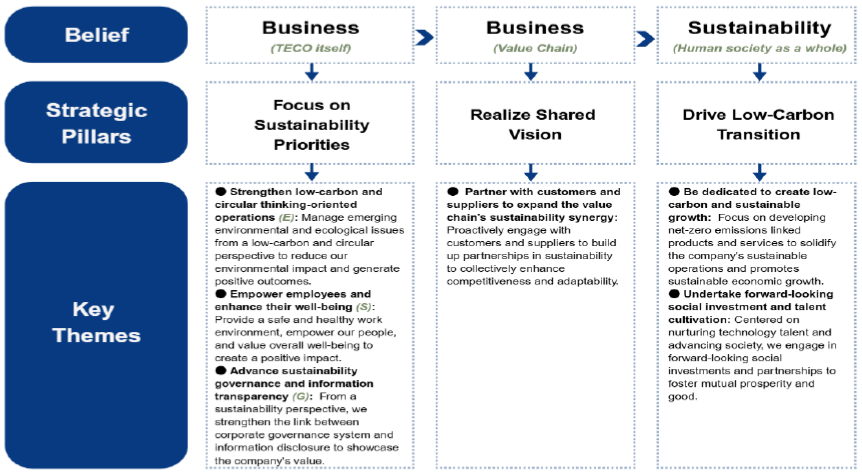
ESG Strategy Framework
TECO’s ESG framework, rooted in the B2B2S philosophy, emphasizes core ESG topics within operations (first “B”), collaboration with customers and suppliers for a sustainable value chain (second “B”), and societal low-carbon transition through economic growth and social investments (“S”).