
Focus on Sustainability Priorities
This represents the first ESG pillar derived from the TECO B2B2S philosophy, focusing on the primary ESG topics within the company's own operations.
_2-20(1).png)
Risks of Force Majeure or Unforeseen Transition FailureRisk Management2024 Achievements Summary
| Key Issues |
|
||
| Force majeure or unforeseen transformation failure risks |
|
||
| Hedging Management |
|
||
| 2024 Performance Summary |
01. Renewable Energy and Carbon Management Performance
02. Talent Equity and Organizational Resilience
03. Waste Reduction and Recycling Implemented waste reduction and recycling mechanisms, integrated with KPI management.
04. Information Security Management
These initiatives have been incorporated into the annual KPI framework and linked to the performance evaluation system for senior executives to strengthen organizational sustainability implementation. |
||
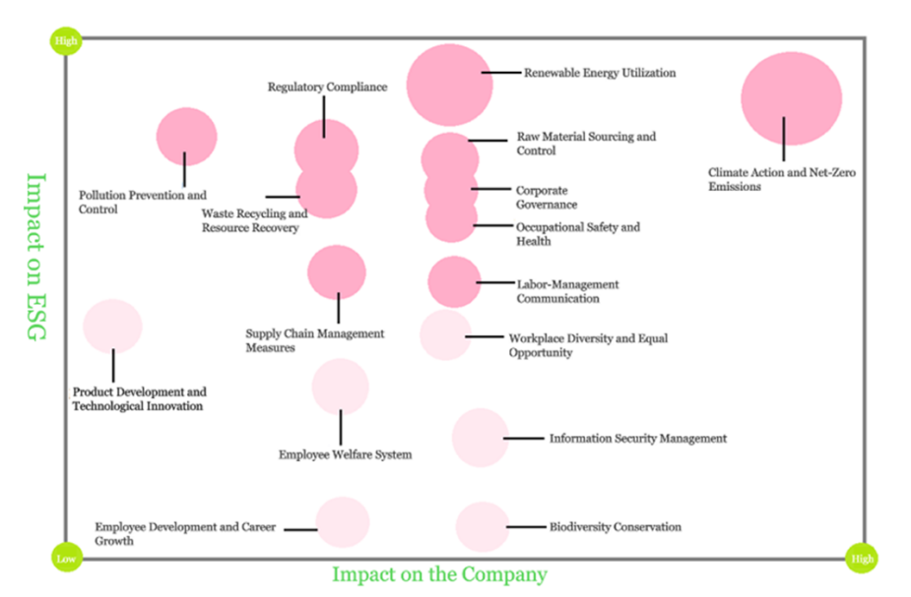
Prepared per GRI Standards, our materiality analysis integrates the EU’s double materiality principle, evaluating internal and external ESG impacts. A detailed table outlines 16 industry topics’ impacts and mitigation measures. In 2024, 215 questionnaires (Taiwan 71%, China 21%, Other regions 8%) identified 10 high-impact topics, presented in the “Material Topics Matrix Chart.” Key areas include “Regulatory Compliance,” “Corporate Governance,” and “Climate Action and Net-Zero Emissions.” Stakeholder feedback informs internal reporting.
Environment(E): Strengthen operations based on low-carbon and circular thinking
Climate Transition Risk Scenario Analysis
According to the scenario analysis published by the Network of Central Banks and Supervisors for Greening the Financial System (NGFS), if current trends continue, global temperatures are projected to rise by 1.5°C by 2030, 2°C by 2050, and 3°C by 2090. Under a 3°C temperature increase, physical impacts include a 10% reduction in labor availability due to heat. River flooding is expected to double in China and triple in India. Typhoon and cyclone frequency will increase by 16% in Japan, 12% in the Philippines, and up to 47% in the U.S. Economically, natural disasters could reduce global GDP by 2% by 2040, stalling economic development in many countries. Achieving net zero by 2050 would limit the temperature rise to 1.4°C, offering future generations an opportunity for change. The greatest transition risk arises from inadequate control of emission reduction pathways, potentially missing the last chance to avoid climate tipping points.
The NGFS NET ZERO 2050 scenario (1.4°C global warming by century-end) requires a fivefold increase in renewable energy, 50% electrification in residential and commercial sectors (including building material production), 40% use of net-zero fuels (e.g., hydrogen, biodiesel), 5 billion tons of carbon sequestration annually, improved energy efficiency, a 60% reduction in energy intensity, and decarbonization of agriculture, forestry, and land use (afforestation and oxygenation measures).
TECO’s Response Measures
Emission Reduction Strategy
_2-24_04(1).png)
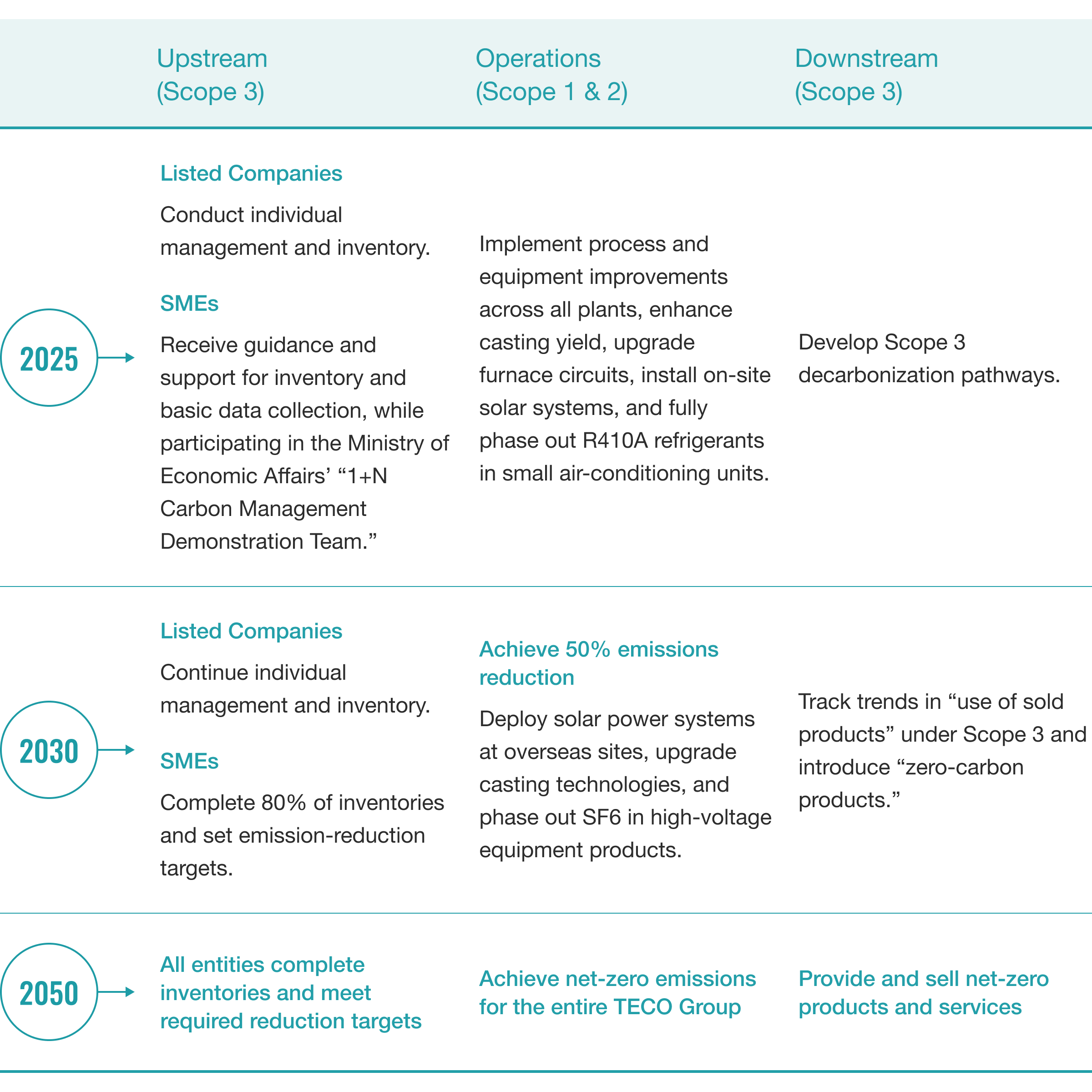
TECO Global Value Chain and Greenhouse Gas Inventory
Internal Carbon Pricing (ICP) System
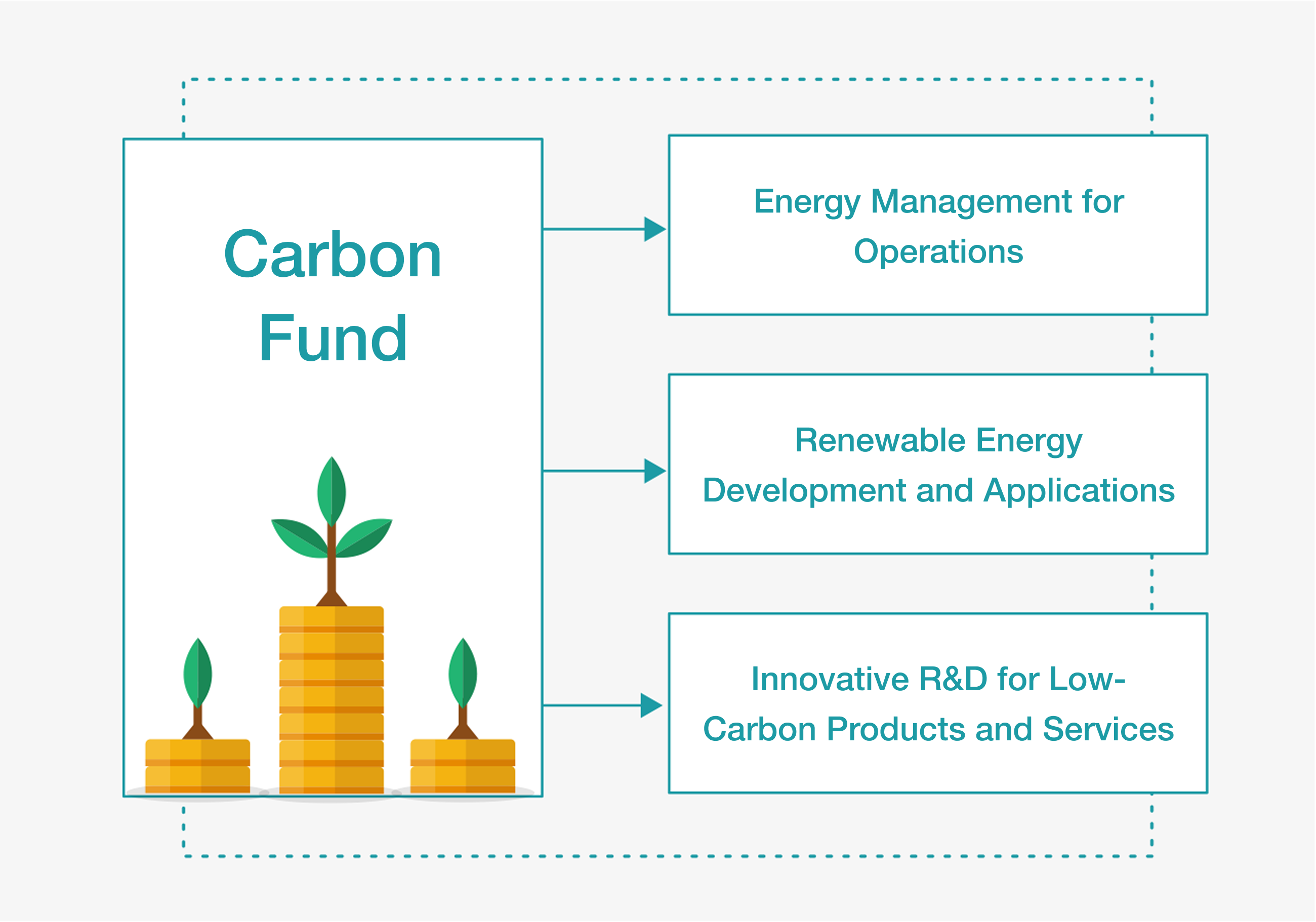
To advance low-carbon development and accelerate the Group’s carbon reduction performance, TECO implemented the Internal Carbon Pricing (ICP) system in 2023, following board approval, as an incentive mechanism for internal performance management. ICP is guided by the “polluter pays” principle, with the Group uniformly charging business units for carbon emissions. By setting carbon fees, each production site self-regulates emissions, improves energy efficiency, promotes lower-carbon production processes, identifies and captures low-carbon opportunities, and develops innovative technologies. The ICP aims to motivate all employees to consider carbon emissions related to their work as a critical priority. Currently, TECO’s internal carbon price is set at NT$1,600 per ton of CO2e. General Managers of the three major business groups are assigned annual emission targets and budgets to pay the internal carbon fee. Exceeding the target results in higher payments, directly impacting business group performance and bonuses.
To enhance overall carbon management effectiveness and encourage innovation, and to achieve short- and medium-term emission reduction targets as well as net zero by 2050, in 2024 TECO further established the "ICP and Carbon Fee Payment & Management Procedures." The General Manager serves as the convener of the "ICP and Carbon Fee Management Team." Besides reviewing the internal carbon price annually, the procedure optimizes the use of the accumulated carbon fund as a financia
Energy Management Plan
| TECO Energy Management Plan | 2024 Management Actions |
|---|---|
| Conduct energy audits to identify opportunities for efficiency improvement | In accordance with the ISO 14001 Environmental Management System and internal procedures, TECO conducts annual energy audits to analyze the types and usage of energy at each operational site, identify major energy hotspots, and develop effective energy-saving and carbon-reduction plans. |
| Quantitative energy-saving targets | Based on energy usage across TECO’s global production sites (coverage 84.34%), energy sources include natural gas, diesel, gasoline (Scope 1), and purchased electricity (Scope 2). Scope 2 energy consumption targets a 5% annual reduction, while Scope 1 targets aim for 30% of operational electricity consumption to come from renewable energy by 2030. |
| Actions to reduce energy consumption | In 2024, 27 energy-saving and carbon-reduction projects were implemented, saving 591,654 kWh of electricity (using Taiwan 2023 electricity emission factor of 0.494 kg CO₂e/kWh), equivalent to approximately 290 tons of CO₂e reduction. Since 2021, electricity management guidelines have been introduced, reducing 39,306 MWh compared with 2021, promoting energy-saving variable frequency equipment, adding shading devices, increasing illumination, and improving long-term energy use. The Group also plans to establish energy-intensive facilities and promote facility upgrades. |
| Progress in reducing energy consumption | In 2024, the above energy-saving and carbon-reduction projects saved a total of 591,654 kWh, reducing emissions by 29 tons of CO₂e (calculated using Taiwan 2023 electricity emission factor). |
| Use of renewable or alternative energy | In 2024, TECO activated 6.7 MW of solar power in the U.S. and China. Combined with existing capacity, global solar installation reached 15.45 MW. In 2025, the Group plans to expand electricity purchase agreements, targeting 30% renewable energy use across global production sites by 2030. |
| Invest in or procure equipment to reduce energy consumption | In addition to energy-saving and carbon-reduction projects, high-energy-consuming equipment is being replaced and efficiency improved, including equipment type optimization, reducing the need for cooling fans, increasing efficiency, and extending equipment lifespan. |
| Employee training on energy efficiency to raise awareness | TECO promotes energy-saving training at all production sites, covering case studies, air-conditioning energy-saving, and equipment maintenance. In 2024, 730 participants received training, accumulating 1,000 hours (2,000 course hours in total). |
Biodiversity and Ecosystem Restoration
Natural Capital Dependency & Risk Management Process
| Value Chain Natural Dependency, Impact & Sensitivity Identification |
|
|---|---|
| Risk and Opportunity Identification & Analysis |
|
| Measurement Indicators & Target Setting |
|
| Monitoring, Communication & Disclosure |
|
Society(S): Empower employees and enhance their well-being
Human Rights Policy Statement
TECO respects and supports the labor standards set forth in the United Nations Universal Declaration of Human Rights, the United Nations Global Compact, and the International Labour Organization Conventions, and is committed to ensuring that every individual within TECO, its stakeholders, supply chain, and partners—including but not limited to regular employees, contract employees, suppliers, contractors, new business relations (mergers, acquisitions, joint ventures), customers, and local communities—is treated equally and with dignity. Our Human Rights Policy Statement is as follows:
01. Investment
02. Fairness and Non-Discrimination
03. Fostering Good Labor-Management Relations
04. Prohibition of Child Labor
05. Prohibition of Forced and Compulsory Labor
06. Working Hours
07. Fair Compensation and Living Wage Assurance
08. Safe and Healthy Work Environment
09. Education and Training
10. Suppliers
11. Open Communication Channels for Employee Rights
12. Handling Major Violations
Talent Development Programs
Performance Measurement and Long-Term Incentives
Weighting of Sustainability Performance in KPIs
| Applicable Personnel | Weighting of Sustainability Performance in KPIs | Indicator Content |
|---|---|---|
| General Manager and Business Group GMs | 2% | Total carbon emission reduction attainment, carbon intensity improvement, green supply chain advancement |
| GMs of Key Manufacturing Subsidiaries | 4% | Total carbon emission reduction and intensity improvement, effectiveness of key carbon reduction projects, status of green supply chain achievement |
| GMs of Sales Subsidiaries | 4% | Carbon intensity improvement, growth in low-carbon product sales ratio |
| Middle/Senior Managers and Sustainability Project Personnel | Individually set | ESG project progress and performance indicators, differentiated KPIs designed according to departmental responsibilities. |
Labor Union and Labor-Management Conferences
To enhance work efficiency and improve labor conditions, and to promote smooth communication and coordination between labor and management, the TECO Company Industrial Union was established in July 1974. To safeguard the rights of both labor and management and foster a harmonious and unified relationship, TECO and representatives of the Industrial Union signed a collective bargaining agreement starting December 28, 1981. The process was re-initiated in 2018 and spanned 4 years, involving a total of 13 negotiation meetings. During this period, both parties upheld the spirit of labor-management autonomy and the principle of good faith to negotiate matters related to employee labor conditions, welfare measures, occupational safety, internal grievance systems, union operations, and the use of company facilities.
Both parties successfully signed an updated collective bargaining agreement on February 21, 2023. This agreement stipulates several terms that are superior to current labor laws. The revised collective bargaining agreement is effective for a period of 3 years, from the signing date until February 20, 2026. All union members are protected by this agreement.
The union holds an annual general assembly for members each year, and union directors and supervisors are re-elected every four years. A biannual symposium is held between the Chairman, General Manager, and the union's directors and supervisors. Member representatives are elected by member vote, and 11 union directors and 3 supervisors are elected. Monthly union director and supervisor meetings are held to discuss various issues relevant to employees, and the company attends these meetings for communication.
A union office is currently established within the factory premises, allowing employees to communicate and exchange opinions with union representatives at any time. The company also holds biannual symposiums where union directors and supervisors can communicate directly with the General Manager. Furthermore, an annual selection and commendation event for outstanding laborers is organized, selecting one individual per 100 employees. All company operational activities and significant changes to employee work procedures adhere to the requirements of the Labor Standards Act.
Data disclosure scope: Taiwan parent company, accounting for 42.7%. Among these, there are 1,983 employees eligible to join the labor union, and 1,983 employees participating in the union (100%).
TECO has also established various grievance channels, such as regularly held quarterly labor-management consultation meetings, and ad-hoc meetings can also be convened as important avenues for employee communication regarding rights and interests, ensuring regularized labor-management interaction. Discussion items at labor-management consultation meetings include personnel changes, company business development and talent development needs, salary and benefits, working environment, and grievance matters. Employees can safeguard their rights through the company system or by providing feedback to labor-management representatives to ensure protection of rights and maintain positive interactions between both parties.
TECO Group has labor union organizations in Taiwan, Wuxi (China), Mexico, and Vietnam, accounting for 60.7% of the entire Group’s core business operations.
Occupational Safety and Health Maintenance
Major Occupational Safety Accident Handling Procedures
| Immediate Reporting and On-Site Response |
|
| Preliminary Investigation and Stakeholder Communication |
|
| Root Cause Analysis and Third-Party Audit |
|
| Incident Prevention and System Enhancement |
|
| Remediation Measures and Compensation Mechanisms |
|
| Performance Tracking and Continuous Disclosure |
|
DEI Activities
In 2024, a DEI training course titled "Mastering Gender Perspective for a Respectful and Inclusive Workplace Environment" was launched. Employees can access this course online via the "TECO e-Academy" platform, achieving a completion rate of 64.8% for all employees and 63.98% for management roles.
- Since 2022, the company has actively promoted gender equality and a DEI culture. Through systematic planning, we aim to foster a sense of identity and enhance participation in DEI among TECO employees internally, while externally positioning TECO as a company that respects differences and values talent diversity to potential applicants.
- Our promotion efforts were recognized in 2024 when we received several honors: the "Diversity and Inclusion Vision Award - Gold" from Womany, the "Taipei City Gender Equality Certification - Silver Award," and the "DEI Friendly Senior Employer Award."
Governance(G): Advance sustainability governance and information transparency
Sustainable Governance
Nomination and Selection Processes of the Highest Governance Bodies and Their Committees
- Audit Committee: Composed entirely of independent directors, with one independent director appointed as convener and chair.
- Remuneration Committee: Comprising at least three members, with a majority being independent directors. Members elect the convener and chair among themselves.
- Corporate Governance and Sustainability Committee: Consists of three or more directors and is responsible for sustainability strategy planning and oversight of governance effectiveness.
- Nomination Committee: Composed of at least three directors, with a majority being independent directors. The convener is elected by members; in the current term, the Chairman, Li Mingxian, serves as convener.
- Strategy Committee: Comprised of at least three directors or external experts, with the Chairman serving as convener and meeting chair, assisting in formulating long-term development strategies.
Executive Compensation Metrics
Executive performance is evaluated quarterly based on KPIs. Key performance indicators include Value-Added Management, Accelerated Operations, In-Depth Management, and Forward-Looking Planning. Approximately 60% of the evaluation metrics are linked to financial indicators (e.g., revenue, operating profit, net income, total asset turnover, return on assets, return on invested capital, etc.), while 40% are tied to short-, medium-, and long-term planning, execution, and sustainability KPIs. Sustainability KPIs cover three main indicators: carbon emissions, carbon intensity, and green supply chain robustness (assessed through greenhouse gas inventories). KPI achievement rates are directly linked to variable bonuses. Additionally, starting in 2023, an internal carbon pricing mechanism (NT$1,600 per ton) has been implemented, with carbon fees applied, impacting business unit profitability and, consequently, executive compensation.
Long-Term Incentive Mechanism
The company established the "TECO Motor Cohesive Shareholding Committee," allowing managerial-level employees to contribute a portion of their monthly salary, with the company matching contributions to purchase company shares via a trust. TECO continues to optimize long-term incentive programs and increase the proportion of employees evaluated on sustainability indicators. This mechanism strengthens the alignment between executive rewards and medium- to long-term company performance, enhancing employee engagement, loyalty, and shared ownership of company achievements.
Sustainability Information Management Procedures
To implement sustainable governance and ensure the quality and reliability of sustainability information, TECO has established the "Sustainability Information Management Procedures." This serves as the standard operating process for collecting, consolidating, verifying, and disclosing sustainability information internally. It aims to enhance cross-department collaboration and improve the accuracy, consistency, and completeness of information. Through this procedure, TECO minimizes the risk of misstatements in public disclosures while ensuring compliance with applicable regulations, transparently and reliably addressing stakeholder expectations regarding sustainability performance.
IFRS S1 and S2 Disclosure Preparation
TECO has initiated preparations for sustainability information disclosure in compliance with international standards. The Finance Department serves as the primary responsible unit, with the ESG Office acting as co-executive secretary, collaborating with key business and support units to prepare and inventory information in accordance with IFRS S1 “General Requirements for Disclosure of Sustainability-related Financial Information” and IFRS S2 “Climate-related Disclosures.” To enhance completeness and compliance, external consultants have been engaged for preliminary assessment and guidance, ensuring disclosure mechanisms align with global sustainability reporting trends and providing a solid foundation for future sustainability performance management and transparent reporting.
Role of the ESG Office
The ESG Office reports directly to the Chairman and is responsible for driving sustainability initiatives:
・Consolidate international trends and industry characteristics to develop group sustainability strategies and implement net-zero emission goals.
・Foster a sustainability culture and strengthen sustainability empowerment.
・Plan and execute sustainability projects, monitoring progress to enhance competitiveness.
・Assess responses to key international initiatives and actively engage with stakeholders.
・Disclose TECO’s sustainability performance and aim for strong results in domestic and international ESG ratings and benchmarks.
Business Ethics and Governance of Group Subsidiaries
TECO has issued the "TECO Sustainability Management Commitment Letter" requiring all employees to comply. For supplier management, we follow the "Supplier Code of Conduct" and require suppliers to sign back a "Human Rights and Environmental Sustainability Commitment Letter" concurrently when signing procurement contracts. For listed companies within the consolidated annual report scope and all manufacturing subsidiaries with controlling power, the "TECO Group Sustainable Management Policy and Commitment" serves as a guiding principle, regulating business direction in environmental, social, and governance (ESG) domains to ensure the implementation of the Group's overall sustainable development policy and satisfy the requirements and expectations of stakeholders.
_2-67_03.png)
Information Security Management
Stakeholder Engagement and Material Topics
Stakeholder Identification and Communication
Stakeholder identification is conducted by the ESG Office. The identification method, referencing the AA1000 Stakeholder Engagement Standard, categorizes the stakeholder list into seven groups: shareholders, employees, customers, suppliers, local communities, civil organizations and NGOs, and the government. TECO conducts a double materiality analysis, considering both financial and ESG aspects of each topic. This approach aims to balance financial indicators in guiding the sustainable actions of our business units towards external stakeholders.
Stakeholder: Shareholders
| How Identified | Those who hold publicly issued stock |
|---|---|
| Purpose of Engagement | Maintaining investor confidence |
| Communication Channels / Response Methods / Frequency | ● Market Observation Post System (MOPS) ● Shareholders' Meetings: Convened at least once a year ● Host four online investor conferences annually ● Occasional participation in domestic and international investment forums ● Ad-hoc reception of visiting institutional investors or meetings with brokerage firms ● Investor Relations / Shareholder Services Dedicated Phone Line and Email: Prompt responses by assigned personnel ● Contact Person: (IR) Director Chien (ir@teco.com.tw) |
| Communication Effectiveness / Outcomes | ● Included as a constituent stock of the "Dow Jones Sustainability Index" and the "FTSE4Good TIP Taiwan ESG Index." ● Monthly revenue, quarterly financial reports, and various operational information are publicly announced on the Market Observation Post System (MOPS) and the company website. ● In 2024, four online investor conferences were hosted, with Chinese and English video links uploaded to the Market Observation Post System (MOPS) and the company website. ● Participated in 8 domestic and international investment forums by invitation. ● Received 96 visits from investors (excluding investment forums and brokerage analysts), including 26 foreign institutional investors; held 21 proactive visits to brokerage firms. |
| Reported To | Reported to the Board of Directors by the Corporate Governance Center |
Stakeholder: Employees
| How Identified | Internal regular employees or contract staff |
|---|---|
| Purpose of Engagement | Fostering labor-management harmony |
| Communication Channels / Response Methods / Frequency | ● Labor-management meetings: Quarterly ● Union roundtables: Semi-annually ● Catering Committee Meetings: Quarterly ● Employee Quarterly Meetings: Quarterly ● Occupational Safety and Health Committee: Quarterly ● Employee satisfaction survey: Annually ● Electronic Bulletin Board: Ad-hoc Announcements ● Workplace Misconduct/Harassment & Grievances: HRP@teco.com.tw ● Contact Person: (HR) Director Lin (cplin@teco.com.tw) |
| Communication Effectiveness / Outcomes | ● Labor-Management Meetings: 22 meetings held across Nangang and various plant locations in 2024. ● Union Roundtables: Two semi-annual meetings were conducted, involving the Chairman, President, plant managers, Human Resources Center director, supervisor, and union directors and supervisors. ● Catering Committee Meetings: 13 meetings held across Nangang and various plant locations in 2024. ● Employee Quarterly Meetings: A total of 8 meetings were held across Nangang and various plant locations in 2024. Four of these meetings in Nangang were conducted online via remote communication software, enabling virtual attendance for employees from all plants. ● Employee Satisfaction Survey: Opinions of employees and supervisors were gathered and analyzed through adaptive methodologies. ● Workplace Misconduct/Harassment & Grievances: A total of 6 cases were filed (4 complaints upheld; 2 not upheld). ● Electronic Bulletin Board: Ad-hoc announcements covering various employee welfare matters, Welfare Committee information, important company operational updates, education and training course details, and annual performance management procedures. |
| Reported To | Reported to the President and the Chairman by the Human Resources Center. |
Stakeholder: Customers
| How Identified | Customers who made purchases from TECO during the reporting period |
|---|---|
| Purpose of Engagement | Maintaining Brand Recognition and Loyalty |
| Communication Channels / Response Methods / Frequency | ● Customer Satisfaction Surveys: 1-4 times annually ● Customer service hotline: as needed ● Distributor Roundtables: 1-4 times annually, supplemented by ad-hoc distributor visits ● After-Sales Service Tracking: Post-service follow-up calls after each service event ● Official website and media: updated as needed ● Contact Person: (Spokesperson) Director Chien (speaker@teco.com.tw) |
| Communication Effectiveness / Outcomes | ● Customer satisfaction survey analysis and countermeasures conducted 7 times annually. ● Regular external audits of the Quality Management System (2024/10–2024/11) were conducted 5 times. Internal audits were 9 times; process audits were 97 times; and product audits were 42 times. ● 4 media press conferences were held. ● Participated in 7 exhibitions, including Smart City Summit and Expo, E-Mobility Taiwan, Energy Taiwan, Intelligent Asia Thailand. |
| Reported To | Reported to the Chairman by the Presidents of each Business Group. |
Stakeholder: Suppliers
| How Identified | Suppliers with procurement transactions during the reporting period. |
|---|---|
| Purpose of Engagement | Ensuring sound supply chain operations |
| Communication Channels / Response Methods / Frequency | ● Supplier evaluation: 70 suppliers annually ● Supplier audit: Quarterly ● Supplier greenhouse gas (GHG) inventory guidance: as needed ● E-procurement: as needed ● Contact Person: (Procurement) Director Lin (dora@teco.com.tw) |
| Communication Effectiveness / Outcomes | ● Risk assessments and on-site evaluations were conducted for key suppliers. ● Suppliers signed Corporate Social Responsibility (CSR) commitment letters, achieving 100% signing rate among major suppliers. ● Participated in the 1+N Net-Zero Transformation Promotion Project of Industrial Development Administration, MOEA. Carbon management guidance was provided to 34 suppliers and related enterprises, and 4 series of carbon management courses were held. |
| Reported To | Reported to the Chairman by the Presidents of each Business Group and the ESG Promotion Office. |
Stakeholder: Local communities
| How Identified | Industrial Park authorities and nearby communities where we have operations |
|---|---|
| Purpose of Engagement | Maintaining Positive environmental and social relations |
| Communication Channels / Response Methods / Frequency | ● Industrial Park Service Centers: Ad-hoc ● Industrial Park Joint Defense Initiatives: Quarterly ● Company Website Communication Mailbox: Ad-hoc ● Volunteer activities: Quarterly ● Contact: (PR) Manager Chiang (pr@teco.com.tw) |
| Communication Effectiveness / Outcomes | ● No violations of air pollution emissions or waste management regulations, nor incidents impacting communities. ● Participated in regional joint defense initiatives, fostering inter-company disaster preparedness exchanges to prevent incidents from affecting community environment and safety ● Conducted energy conservation education for local communities and schools. ● Employee participation in public welfare activities totaled 582 person-times, with 1,134 total volunteer hours. |
| Reported To | Reported to the Chairman by general managers of each business group. |
Stakeholder: Civil Organizations and NGOs
| How Identified | Industry Associations or Partner Organizations |
|---|---|
| Purpose of Engagement | Maintaining Positive industry and social relations |
| Communication Channels / Response Methods / Frequency | ● Active participation in various civil associations ● Forums and seminars organized with academic institutions ● Non-financial information disclosure: Annual publication of the corporate sustainability report, detailing concrete actions and outcomes across Environment (E), Social (S), and Governance (G) aspects ● Contact: (IR) Director Chien (ir@teco.com.tw) |
| Communication Effectiveness / Outcomes | ● Participation in business organization forums: 22 sessions involving 50 participants. ● Awarded the Taiwan Corporate Sustainability Report Platinum Award for 11 consecutive years. ● Greenhouse gas (GHG) inventory: Annual verification by British Standards Institution (BSI) against ISO 14064-1, achieving "reasonable assurance level." |
| Reported To | Reported to the Chairman by general managers of each business group. |
Stakeholder: Government agencies
| How Identified | Competent Authorities related to business operations |
|---|---|
| Purpose of Engagement | Maintaining Strong economic and governance performance |
| Communication Channels / Response Methods / Frequency | ● Comply with statutory requirements from competent authorities and submit regular reports ● Participation in forums, public hearings on regulations, and official correspondence organized by competent authorities: Ad-hoc ● Cooperate with supervision and audits by competent authorities ● Contact Person: (Spokesperson) Director Chien (speaker@teco.com.tw) |
| Communication Effectiveness / Outcomes | ● Maintained compliance with statutory requirements from competent authorities, cooperated with regulatory supervision, submitted regular reports, and underwent audits. |
| Reported To | Reported to the Board of Directors by the Corporate Governance Center |
Material Topics
| No. | Topic | Explanation of Positive and Negative Impacts | Business activities and sustainable development | Economy, environment, and society | ||
|---|---|---|---|---|---|---|
| Positive | Negative | Positive | Negative | |||
| 1 | Product R&D and Technological Innovation | Positive: Seizing new business opportunities; becoming an industry leader Negative: High cost and high risk; uncertain market acceptance |
● | ● | ● | ○ |
| 2 | Renewable Energy Utilization | Positive: Reduced energy costs, decreased carbon emissions, and compliance with environmental regulations Negative: Initial increase in capital expenditures, potentially impacting short-term capital spending and financial performance |
● | ● | ● | ○ |
| 3 | Waste Recycling and Resource Recovery | Positive: Enhanced corporate image and brand value; creation of additional revenue Negative: Increased in operational and management costs |
● | ● | ● | ○ |
| 4 | Pollution Prevention and Control | Positive: Enhanced corporate risk management and long-term competitiveness Negative: High installation and maintenance costs for pollution prevention equipment, leading to increased capital expenditures |
● | ● | ● | ○ |
| 5 | Biodiversity | Positive: Reduced regulatory risks related to land use and ecological destruction Negative: Ecological restoration or compensation measures may incur additional financial burdens |
○ | ○ | ● | ○ |
| 6 | Employee Training and Career Development | Positive: Enhanced employee capabilities and improved organizational competitiveness. Negative: If a transparent career advancement system is not established, it may lead to the risk of employee turnover |
● | ● | ● | ● |
| 7 | Workplace Diversity and Equal Opportunity | Positive: Promotion of an inclusive organizational culture and innovative thinking; enhanced decision-making quality and team collaboration. Negative: Requirement for resource investment in system design, education and training, and cultural communication |
● | ● | ● | ● |
| 8 | Employee Benefits and Welfare | Positive: Improved work efficiency and productivity; talent attraction. Negative: Potential for resource misallocation or negative employee perception if welfare programs are poorly designed. |
● | ● | ● | ● |
| 9 | Labor-management communication | Positive: Reduced labor disputes and legal risks; enhanced employee engagement and organizational stability. Negative: Potential for stakeholder scrutiny if issues are not properly recorded and addressed. |
● | ● | ● | ● |
| 10 | Occupational Safety and Health | Positive: Reduced the incidence of workplace injuries and occupational diseases Negative: Higher costs required for establishing safety management systems and conducting training. |
● | ● | ● | ● |
| 11 | Corporate Governance | Positive: Promotion of corporate sustainable development Negative: Potential for stakeholder scrutiny and decreased trust if governance information is inadequately disclosed |
● | ● | ● | ● |
| 12 | Regulatory compliance | Positive: Reduced operational and legal risks; enhanced corporate stability and market reputation Negative: Increased operational complexity due to multinational regulations and emerging sustainability standards |
● | ● | ● | ● |
| 13 | Supply chain management measures | Positive: Enhanced operational resilience and stability Negative: Increased management complexity, along with heightened supervision and audit complexity |
● | ● | ● | ● |
| 14 | Information Security Management | Positive: Protection of customer and corporate data security; maintenance of operational stability and brand trust Negative: Potential for management vulnerabilities and increased internal risks due to insufficient employee cybersecurity awareness |
○ | ● | ● | ● |
| 15 | Raw Material Sourcing and Control | Positive: Promotion of supply chain transparency and sustainable development Negative: Higher costs for establishing traceability mechanisms |
● | ● | ● | ○ |
| 16 | Climate Action and Net-Zero Emissions | Positive: Increased competitiveness and market opportunities Negative: Higher initial investment in transformation costs |
● | ● | ● | ○ |
Material Issues for Enterprise Value Creation
| Category |
Global Economic Policy Challenges: Building North American and Indo-Pacific Supply Chains |
Renewable energy use: energy generation and storage |
Innovative business opportunities and R&D: Clean technology projects |
|---|---|---|---|
|
Material Risk or Opportunity |
As the global economic situation changes, Taiwan's CPI rises, the United States has inflation, and China has deflation. New geopolitical changes have affected tariffs, trade embargoes, and supply disruptions, causing changes in supply chain models. In response to global economic policy challenges, TECO has established North American and Indo-Pacific supply chains to cope with cost changes. | Extreme climate events lead to power shortages, which interrupt corporate operations. TECO uses renewable energy to reduce dependence on external power supply and reduce operational risks. | In response to various countries' policy support for green energy, energy conservation and carbon reduction, TECO seizes innovative business opportunities and develops clean technology projects to increase its revenue sources. |
| Business Case | As global economic and geopolitical changes, as well as the intensification of trade disputes, lead to the implementation of new tariffs and trade embargo policies, this will directly affect
TECO's import and export business and the flow of raw materials and products. In addition, geopolitics affects the stability and predictability of various markets, affecting TECO's production efficiency and supply stability. Therefore, TECO needs to balance between different markets in supply chain management, and how to cooperate with the original production base has become a challenge for TECO supply chain management to ensure cost and supply stability. |
Power shortages caused by extreme climate events are a common problem around the world. As a multinational company, TECO has multiple global production bases, which has led to increasingly frequent interruptions in corporate operations. This not only disrupts production and delays orders, but also increases the risk of default on orders. TECO must have the ability to create and store electricity in order to respond to external changes in a timely manner. |
Nation's policy requirements for green energy, energy conservation and carbon reduction, for example, the United States' green electricity subsidies and Taiwan's 2050 net-zero transformation
plan promote the rapid development of the new energy market. TECO has moved from motor sales to energy transformation services. In addition to playing an important role in the IDC computer room engineering industry, TECO has recently experienced strong growth in offshore wind power, offshore onshore substations, and energy storage. The newly established power generation and storage division will integrate resources to pursue virtual power generation opportunities for power privatization, allowing TECO to provide more diversified and high value-added energy solutions, thereby increasing revenue sources. |
| Business strategies | In response to geopolitical shifts, TECO has established production bases in emerging regions such as Vietnam, India, and Mexico to cultivate its supply chain. Construction of the existing production bases in Mexico and India has been completed, and TECO will continue to develop short-chain production centers to meet market growth and production capacity diversification needs in various regions around the world. | Through the creation of energy conservation and renewable energy (solar energy), we aim to achieve the phased RE30 goal by 2030, and continue expanding solar installations across Europe,
America, Australia, and Asia. In 2024, TECO added 5.7 MW of new solar capacity in the U.S. and China, bringing total global installed capacity to 15.73 MW. The total electricity generated from own facilities in 2024 reached 11.92 million kWh, and 1,038 Taiwan Green Electricity Certificates were obtained. By 2030, TECO expects renewable energy to account for 30% of total electricity consumption |
TECO is focusing on medium- to long-term clean technology opportunities, with strategies centered on the development of low-carbon products, participation in both government and private energy storage projects, and the integration of resources to expand into virtual power plant (VPP) operations. These initiatives are designed to capture new power market opportunities driven by energy market liberalization |
| Target/Metric | TECO is expanding its regional short-chain production centers, with facilities in Mexico and India already completed, and the U.S. short-chain expected to be operational in 2025. This strategy enhances supply chain resilience by shortening delivery lead times and reducing dependence on global long-chain production, supporting market growth and capacity diversification. | In 2024, TECO Solar added 5.7 MW of installed capacity, bringing the company's global photovoltaic installed capacity to 15.73 MW. This year, TECO generated 11.92 million kWh of self-generated electricity and obtained 1,038 Taiwan Green Power Certificates. Looking ahead, TECO will continue to increase the proportion of its own renewable energy generation and storage capacity to mitigate external energy risks and support the achievement of its emissions reduction targets. The long-term goal is for renewable energy to account for 30% of total electricity consumption by 2030. |
ECO's Clean Technology Engineering sets a mid-term revenue growth target of 9% and a long-term target of 34% by 2025. |
| Target Year | 2025 | 2030 | 2025 |
| Progress | TECO has established regional short-chain production centers to strengthen supply chain resilience. In 2023, the Mexico and India production bases were completed, supporting global capacity diversification. In 2025, the U.S. short-chain production center is scheduled for completion, further shortening delivery lead times and reducing reliance on global long-chain supply. |
In 2024, TECO expanded its solar power generation facilities by adding 5.7 MW of new capacity in the United States and China, bringing the company's total installed solar capacity to 15.73
MW. During the year, TECO's own facilities generated 11.92 million kWh of electricity, and the company obtained 1,038 Taiwan Green Electricity Certificates, contributing to its renewable energy transition. |
To accelerate its transformation into a virtual green power plant, TECO established the Innovative Energy Storage Operation & Development Division in 2023. By leveraging both self-owned projects and EPC projects—including investment in solar power plants, EPC construction of energy storage systems, and sales of related equipment—TECO has steadily expanded its renewable portfolio. In 2024, the company added 5.7 MW of new solar capacity in the United States and China, bringing its total installed solar capacity to 15.73 MW. During the year, TECO's own facilities generated 11.92 million kWh of electricity, and it obtained 1,038 Taiwan Green Electricity Certificates, supporting the long-term goal of renewable energy accounting for 30% of total electricity consumption by 2030. |
| Executive Compensation | TECO integrates ESG KPIs into senior executives' variable compensation to align pay with sustainability strategies.
|
The Company integrates ESG KPIs into executives' variable compensation to align pay with sustainability strategies.
|
TECO Electric & Machinery Co., Ltd. integrates ESG KPIs into executives' variable compensation to align pay with sustainability strategies, as outlined in the 2024 Sustainability Report. The President and Business Group GMs have 2% of their performance tied to GHG reduction, carbon intensity, and green supply chain efforts, while Manufacturing Affiliate GMs are evaluated on 4% based on GHG reduction, carbon intensity, key reduction projects, and green supply chain. Sales Affiliate GMs also have 4% linked to carbon intensity and low-carbon product sales growth. Mid-/Senior Managers and ESG staff have individual ESG KPIs tailored to departmental goals. These KPIs are managed under the company's governance framework, with results reviewed by internal audit and Board-level committees to ensure fairness, transparency, and effectiveness. |
Material Issues for External Stakeholders
| Category | Supply Chain Decarbonization | Clean Technology Engineering |
|---|---|---|
|
Material Issue for External Stakeholders |
Current greenhouse gas regulations require listed companies to complete independent inventories by 2025. For small and medium-sized enterprises (SMEs), the requirement is to achieve 80% inventory coverage and set reduction targets by 2030. To support this, guidance and capacity-building measures are provided through initiatives such as the “1+N Carbon Management Demonstration Team”, helping SMEs establish inventories, set reduction pathways, and align with low-carbon transition goals. |
TECO participates in the construction of public projects for renewable energy and resilient power grids in Taiwan, as well as the electrification of natural gas pipelines in the United States. The progress of the project will affect the environment or society. |
|
Topic relevance on external stakeholders |
External stakeholders: Suppliers are key stakeholders affected by this issue, as supply chain carbon reduction directly influences both environmental
and social performance. Topic description: With major countries and corporations committing to net-zero goals, supply chain carbon reduction is essential for achieving Scope 3 emission targets. If suppliers fail to reduce emissions, their long-term viability will be at risk. Positive and negative impacts: Many of TECO’s suppliers are small and medium-sized enterprises (SMEs) that often lack the resources and expertise to conduct greenhouse gas inventories and implement reduction measures. While compliance may increase short-term costs and require additional training, these efforts help suppliers build awareness of carbon management, deliver long-term environmental benefits, and strengthen customer trust, thereby improving competitiveness. 2024 results: To accelerate supply chain transformation, TECO provided GHG inventory guidance and training. In 2024, a total of 34 suppliers completed simplified inventories, while 9 key suppliers completed full inventories under the support of TECO and government programs. Overall impact: These actions help reduce overall supply chain emissions, enhance resilience, and lower potential operational and environmental risks for SMEs, ensuring a more sustainable and competitive value chain. |
External stakeholders: Terminal electricity users are key stakeholders affected by this issue, as their energy choices directly shape environmental
outcomes. Topic description: With global regulations on greenhouse gas reduction tightening, demand for green and renewable electricity is rising. Increasingly, companies seek to purchase renewable power to reduce reliance on traditional fossil fuels and achieve carbon reduction benefits. Positive and negative impacts: The expansion of renewable energy provides clear carbon reduction benefits, but it may also generate localized environmental impacts, such as land use, landscape changes, and noise from solar and wind power facilities. At the same time, uncertainties in the green electricity market and policy frameworks (e.g., adjustments to subsidies) present risks that users must manage. 2024 progress: TECO actively supports renewable energy deployment through public engineering projects for resilient power grids in Taiwan and the electrification of natural gas pipelines in the United States. These efforts directly help end-users reduce electricity-related carbon emissions and indirectly accelerate decarbonization of the broader energy system. Overall impact: Promoting renewable energy enables electricity users to avoid significant negative environmental impacts while enhancing the positive benefits of low-carbon energy, contributing to sustainable energy development. |
| Output Metric | Number of SMEs completing GHG inventories | Green electricity volume delivered to end users |
| Impact Valuation | Generated economy benefits for SMEs | Increased environmental value by decreasing SCC from fossil fuel usage |
| Impact Metric | 34 SME completed GHG inventory from TECO’s help. This action generates NTD 6.8 M value for supply chain. | In 2024, TECO’s self-owned facilities generated 11.92 million kWh of green electricity. This achievement created environmental value by reducing carbon emissions, equivalent to a decrease of approximately NTD 7,709,625 in social cost of carbon (SCC) |
Contact Us
ESG office
- ESG@teco.com.tw